Tuesday, 14 February 2017

A Social Mirror For Teachers

A Social Mirror For Teachers

All of us start eulogizing the role of teachers on the occasion of ‘Teacher’s day’ but are the doings by some sections really call for such act on our part. We have now reached a stage wherein we have to put forth a question to ourselves that as to whether these present day teachers still desrve all the accolades we bestow upon them? Therefore, I would like to put forth the other aspect of these present day teacher’s, as a social mirror to gauge themselves.

I have been closely associated with the education system during the course of my service and watched very closely, what I term as the other half of these teachers. No doubt that a cadre of highly dedicated and outstanding teachers still existing, but their numbers are miniscule. However, I sincerely do not want to hurt their ego and state that my noting is not targeted against them and hence they may excuse my observations regarding remainder of their kind. I have classified the teachers with abominate qualities into three main categories – (1) Those who are primary & secondary stage teachers; (2) Teachers in higher & professional institutions; (3) Teachers who have grown to become administrators.

The main draw back of this first category of the teachers is that majority of them lack motivation and take their duties as mundane rather then a challenge as the future of this Nation is their hands. The other aspect of this category of teachers is that unlike the past when this profession was chosen with the best heads over their shoulders, now a days it has turned out that all those who are left out in the race for the coveted jobs or opportunities opt for this profession, more as a matter of last resort rather than by choice. I have also observed first hand that the frustration, of not getting what they aspired for, makes them depressed & disillusioned with the Society. As a result of this, they behave like animals with the students, neither sharing their feelings nor trying to understanding the students’ predicament. This is apparent especially in Government run institutions or those aided by the Government despite the fact that these teachers are one of the best paid in comparison to those having employment outside this specified sector with all kinds of perks to go for. The most abhor able character that even further degrades their stature is their demand for money underhand by means of giving private tuitions. Although this is barred by the Government, yet goes on clandestinely. I will give an example wherein the daughter of my ‘Press wallah – Ironing person’ has been failing in Hindi, despite that being their mother tongue, in Class VI since past two years just because he cannot afford to get her daughter to take private classes/tuition for her from the concerned teacher. No doubt that the poor girl may have to drop out of school, but at whose cost?

Although the private run Institutions do not face this problem, specifically so because of the fact that most the parents whose wards study in such institutions are reasonably well placed as compared to their Government school counter parts. But here there is an entire set of priorities which govern the teaching. The teachers for their career sake will help out students whose parents are reasonably well placed as compared with others and as also they will pay special emphasis on the outstanding students. In this run of the mill attitude, the poor average student, who occupies a bench from the second or third rung to just above the last rung are the most affected. However, if the teachers just but browse through the list of persons who have made it good in life, they will find that most of them never had an outstanding academic record but were average students and the leading light amongst them is Thomas Alva Edison. Therefore, is it not the burdened duty upon the teachers to encourage and bring out the best from even the quietest & average of students because you know not which shell shall bring forth a shining pearl?

The next level of educational tier is the Professional Institution or College and therein even upto a few years back the Science stream was the most preferred. The teachers in these Institutions hold a distinct advantage from the first category of teachers discussed hereinabove. The teachers in this category are amongst the best educated and have a healthy salary to go with. However, here to the lack of motivation is apparent and the misgivings of school teachers give way to a kind of arrogance which is uncalled for. The student found to put too many questions are frowned upon and the majority of the teachers just want to complete the course in a routine manner rather than to try and improve the teaching & learning experience. In the Science streams there is another major factor that comes through and that is nepotism. I have seen a Head of Department send back the Botany collection of his nephew as in comparison to the collection made by another fellow student it just paled to oblivion.  This teacher? then impressed upon the outside expert that the collection made by his nephew was far better than anyone else’s. This nephew got the highest marks in the practicals as against the student who had really worked hard for the collection. What impression it would make on a young impressionable mind? Will it not indicate to all students who were present and seen everything themselves that nepotism rather then merit is what makes sense in today’s’ world or in case of modern day ‘Kalyug’ teachers. The awe of teachers is even more pronounced in the professional colleges especially medical colleges where the teachers have assumed a god like aura and openly threaten the students of ruining their careers!  The guides for thesis will make and call for such changes which are not practical and after many a hit and trial methods may come back to the first paper submitted! At what cost and for what purpose, only to satisfy their gloated egos?  The suicides by students, some of which get reported whereas some others just go unreported and to oblivion, who is responsible? Please stand up if you have the guts and acknowledge your responsibility you owe towards the parents of such students & this nation at large!

One can go on and on with what ails our education system. But before closing I will deal with the third category of the teachers turned administrators. Such people are entrusted the task of administering our Education system as they are supposed to know the ‘ins & outs’ of the system having been born in the cadre.  However, even in a simple exercise of granting recognition to Public Schools these individuals in order to make a quick buck will recommend Institutions which do not even meet the basic requirements as designated by the Government. These unscrupulous elements will even go the extent to replace documents/forge records and indulge in all kinds of nefarious activities including attempt to literally eliminate anyone who tries to bring in a semblance of accountability in this entire chain. In whose hands have we entrusted our Education system?

As stated above, I have personally experienced some of the facts stated hereinabove in course of my career. This is a social mirror and I would request all teachers to read this and introspect.
(This article by me was posted in Sulekha.com almost 10 years ago and would like to retain it in my personal blog as well - it elicited some interesting comments - to read the same link to the original blog - http://creative.sulekha.com/a-social-mirror-for-teachers_278225_blog )

Tuesday, 13 September 2016


Divinity of Jageshwar dham

नमः शिवाय
Divinity of Jageshwar dham

Jageshwar temple complex - cocooned in the Doedar forests

Nestled in the Almora district of Uttarakhand, also known at the ‘Land of Gods’, perched at an altitude of 1870 meters (MSL) and lying in the East to North East direction of Almora township, about 37 Kms. ahead towards Bare China and cocooned in the dense forests of Deodar (Cedrus deodara), lies the temple complex comprising the reverend & famed Jageshwar dham. The place finds mention in the ancient treatise of Prasadmandanam, which describes this place as an abode of Lord Shiva and in Sanskrit it is stated as –
हिमाद्रेरूत्तरे पार्श्वे देवदारूवनं परम्
पावनं शंकरस्थानं तत्र् सर्वे शिवार्चिताः।

The Dandeshwar temple complex in Jageshwar

The self appearing Shiva Lingam inside Dandeshwar temple complex
      Jageshwar is the place of Nagesh, 8th among the Dwadasa Jyotirlingas (the ten plus two or twelve resplendent lingas of Lord Shiva established by Lord Vishnu), which is stated to exist in the forest of Deodar or daruka (Sanskrit: दारूक वन, transliteration: daruka van). Renowned Hindu Saint Adi Shankaracharya visited this place and composed this hymn in praise of Lord Shiva -

सौराष्ट्रे सोमनाथं च श्रीशैले मल्लिकार्जुनम् ।
उज्जयिन्यां महाकालमोकांरममलेश्वरम् ।
परल्यां वैद्यनाथं च डाकिन्यां भीमशंकरम् ।
सेतुबंधे तु रामेशं नागेशं दारूकावने ।
वाराणस्यां तु विश्वेशं त्रयंम्बकं गौतमीतटे ।
हिमालये तु केदारं घुश्मेशं च शिवालये ।
ऐतानि ज्योतिर्लिंगानि सायं प्रातः पठेन्नरः ।
सप्तजन्मकृतं पापं स्मरणेन विनश्यति ।
— Dwadasa Jyotirlinga Stotra by famed Hindu Saint Adi Shankaracharya

The saint is also credited with the rejuvenation of Hindu religion & repair of this holy shrine, before he moved ahead to Kedarnath, where he established the famed shrine temple.
Inside courtyard view of Jageshwar temple complex
          There are several mythological stories associated with the formation of the 12 (twelve) Jyotirlingas. Jyotirlinga in Sanskrit means ’Pillar of light’. Although some do not list Jageshwar in the list of 12 Jyotirlingas and identify Nageshwar to be in Dwarka, Gujrat, whereas in some others it does list as being in Jageshwar in Uttarakhand. The twelve Jyotirlingas are listed as follows –
1. Somnath at Prabhas Patan, Saurashtra, Gujarat.
2. Sri Mallikarjun in township of Srisailam,Andhra Pradesh
3. Mahakaleshwar in township of Ujjain, Madhya Pradesh.
4. Omkareshwar in Madhya Pradesh.
5. Vaidyanath temple at Deoghar, Jharkhand.
6. Bhimashankar in Dakini, Maharashtra.
7. Ramalingeswar in Setubandanam, Tamil Nadu
8. Nagesh in Jageshwar.
9. Vishwanath in Benaras, Uttar Pradesh.
10. Tryambakeshwar Jyotirlinga near Nasik, Maharashtra.
11. Kedareswar in Kedarnath Himalayas, Uttarakhand.
12. Ghrishneshwar in Devasrovar, Aurangabad, Maharashtra.

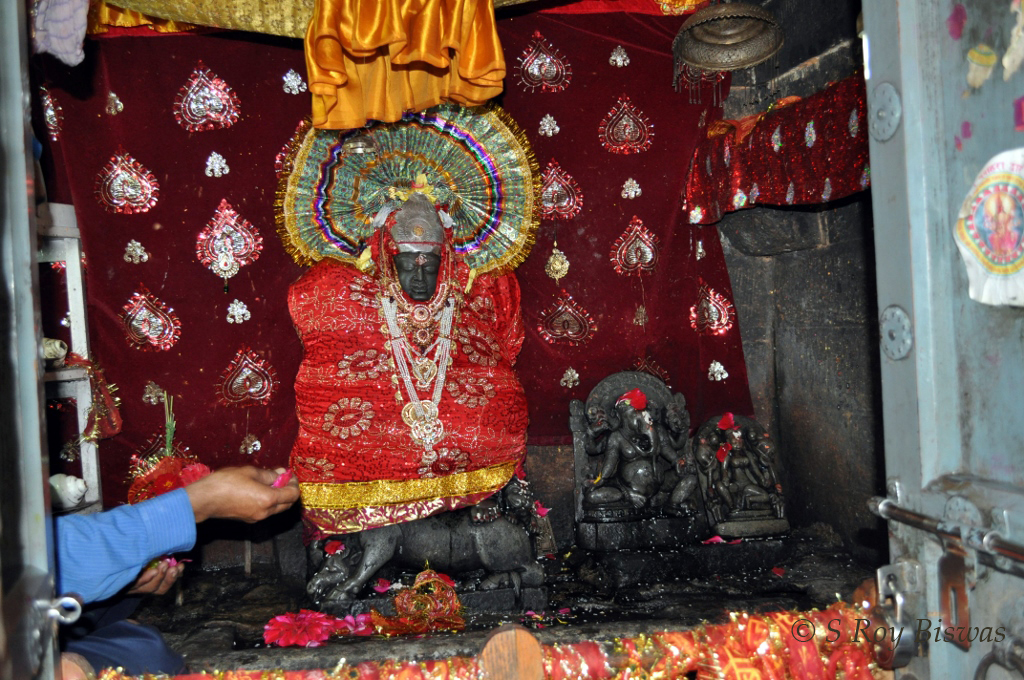
       As stated hereinabove that Jageshwar finds mention in very ancient Hindu texts and therefore, the exact dating of existence of the temples cannot be done definitively. There are about 120 temples in the temple complex and several edicts (about twenty five in number) providing for some clues to the origin of these temples. According to the Archaeological Survey of India (ASI), they belong to the post-Gupta and pre-medieval eras and are estimated to be about 450 yrs old. These temples range in the period from the 8th century (early Katyuri Dynasty) to the 18th century (Chand Dynasty). The temples were renovated during the reign of Katyuri King Shalivahandev. There is an inscription of Malla Kings on the main temple premises indicating their devotion to Jageshwar. The Katyuri Kings also donated villages to the temple priests for its maintenance. The Chand Kings of Kumaon were also patrons of the Jageshwar temple. Numerous Jageshwar temples were constructed or restored during the Gurjara Pratihara era. It is believed that while establishing the various maaths in Uttarakhand, like the Kedarnath and Badrinath dhams, Adi Shankaracharya too had visited Jageshwar and renovated and re-established many temples before leaving for Kedarnath. The Samsan ghat of Jageshwar is also the cremation ground of the erstwhile Chand Kings. The temples architecture belongs to the Nagara style, characterized by a tall curved spire surmounted by an amalaka (capstone) and a kalasha crown. Most of the temples enshrine a stone Lingam, surrounded by stone sculptures of various deities. The pilgrimage to Jageshwar is considered as sacred as the famous Chardham yatra.
Entrance to the Tarun Jageshwar temple

Nandi inside the Jageshwar temple complex

Performing puja inside the Tarun Jageshwar temple
       The folklore in the regions around Jageshwar tells us a gripping story about building the Main temple Near Kot Linga Temple Complex. Lord Shiva selected this place to be his abode. During the Tapasya by Lord Shiva, demons obstructed his penance. Then God "Sam" came into being as Trinetra (the third eye of Lord Shiva), who sent his ‘Ganas’/Demons to kill these demons. It is believed that Lord Sam will come to Kot Linga temple premises to save humanity and Jageshwar in Kalyuga. Adi Shankacharya tried to build the main temple at Kotlinga, but to no avail as Lord Sam wanted Kotlinga to be specifically reserved for the Meditation of his beloved Lord Shiva. Old ruins of a temple structure can be found near Kotlinga. Local people still believe that Lord Sam will come and built the real Jageshwar temple near Kotlinga and thus, save the mankind from adversities of Kalyuga.  It is also believed that anyone who prays here is saved from ‘akaal mrityu’/untimely or sudden violent death.  The temple city comprises a cluster of 124 large and small stone temples, dating 9th to 13th century AD, with many preserved by the  (ASI), which include Dandeshwar Temple which is situated upstream of the main temple complex and is in a more dilapidated condition and the lingam here is of a natural stone that is uncarved and in natural state, known as swayam bhu (meaning self-appearing).    The main temple complex that is situated next to the Jaata Ganga further downstream comprises of the Chandi-ka-Temple, Jageshwar Temple, Kuber Temple, Mritunjaya Temple, Nanda Devi or Nau Durga, Nava-grah temple, a Pyramidal shrine, Surya Temple and the Bhairav temple at the side of the entrance.  Tarun Jageshwar is one of the principal temples situated in the temple premises. The temple has two dwarapalas (door guardians) in the form of the armed Nandi and Skandi. This is a west facing temple of Lord Shiva. Here, Lord Shiva is worshipped in the form of Nagesh/Jageshwar.  In the middle of the temple is the sanctum sanctorum of the temple, the Shivlinga is divided into two parts. The larger one depicts Lord Shiva and smaller one his consort Parvati. An Akhand Jyoti, (an immortal flame) burns in the temple. There are two Asthadhatu statues of the Chand Kings - Deepchand and Tripalchand in the standing posture behind the Shivlinga.
Panoramic view of Mahamritynjaya temple with pyramid shaped temple in front and Deodar trees in the background

The spire of the Mahamrityunjaya temple in Jageshwar - the highest of all
        The most famous of them is the Mahamrityunjay temple, which is the largest and oldest temple in the Jageshwar temple complex. This temple of Shiva is eastern facing and the Linga is worshipped as the saviour from death. The unique linga has an eye shaped opening. Pilgrims believe that reciting the Mahamritunjaya Mantra is a fruitful, auspicious and powerful method of self-realization, removal of evil effects, and freedom from all kinds of fears, illness and negativity. The Mahamritunjaya Mantra is attested in the Sukla Yajurveda Samhita III/60 and reads as –

ॐ हौ जूँ सः
ॐ भूर्भुवः स्वः
ॐ त्रयंबकं यजामहे सुगन्धिम् पुष्टिवधर्नम्
उर्वारूकमिव बन्धनान्मृत्यॊर्मुक्षीय मामृतात्
ॐ स्वः भुवः भूः ॐ
सः जूँ हौ ॐ
    The Yagna pit inside Jageshwar temple
    The statue of Bhairav inside the temple dedicated to the Lord in Jageshwar
The temple dedicated to Kuber in Jageshwar
             Visit to the Jageshwar Dham is not considered to be complete until one visits the temple complex of Vridh or Budh Jageshwar.  This temple complex is situated on a hill top about 3 Kms. from the main Jageshwar temple complex through a pedestrian hill path.  However, in case one wants to visit it by road i.e. using a vehicle, one will have to traverse back upto Bare China junction and therefrom, turn right (while coming from Jageshwar side) and head through a desolate but tranquil road for about 10 odd Kms. till you reach the end of the road, where the temple is situated.  Although there is not definitive written treatise about this place, but as per the folk lore, one of the Chand dynasty Kings who was passing through the place found a cow voluntarily milking itself at a spot and this was repeated regularly for several days.  He then visited the spot to find out a Swayam bhu Shiva linga jutting out of the land.  Since he was proceeding for a war, he prayed at the site and made a promise that in case he won the war, he would construct a temple at the site.  The King won the war and kept his promise.  The stones are said to have been sourced from a place about 10-12 Kms. from the site, a village called Panvanola and the village quarry yielded only those exact number of stones that were required to build the temple.  Inside the temple, a constant source of water flows, whose origins are unknown and this is offered as ‘Charana-amrit’ (Elixir flowing from foot of Lord – literal meaning) to those pilgrims visiting the temple.  It is said that this particular spot offers spectacular views of the Himalayas.  However, as we had visited during the ‘Shravan’ (rainy season) month, when it is considered to be the most auspicious time, the region was all covered with clouds. 
Panoramic view of Budh or Vridh Jageshwar
Another view of the Vridh or Budh Jageshwar
The temple spire of Vridh or Budh Jageshwar
Although we were albiet late while returning back after paying obeisance,  but we were treated to  a spectacular view of a rainbow while returning back.


Panoramic view of hills near Almora with rainbow across

Close up of the many hues of the rainbow
May the blessings of Lord Shiva be always with you…..


Bibliography – 1) Information has been sourced from Widipedia;
    2) Information sourced from the Archaeological Survey of India boards; and  
                           3) Information gathered from the temple priests etc.
                          4) The animated photograph of Lord Shiva has been sourced from the web

Saturday, 10 October 2015

The other dimension of Sheena Bora murder case

The other dimension of Sheena Bora murder case
The murder accused & mother - Indrani Mukherjea (photo courtesy web)

The murdered & deceased daughter late Sheena Bora (photo courtesy web)

Although murder is a daily affair in India and is reported almost on a daily basis, but some cases catch the fancy of the nation, like the ‘Aarushi murder case’, ‘Nithari murder case’, ‘Nirbhaya murder case’ etc. through the News Channels and there is a general hype over the issue or as I phrase it ‘trial by the media’.  I had done an analysis, based upon my legal background in respect of the famed ‘Aarushi murder case’ and finally when the case was closed, most of the issues that had been analyzed by me in my blog, were similar to those of the Central Investigation Bureau or CBI for short, when they filed their charge sheet.

After much hype about the Sheena Bora murder that caught the attention of the Nation during the last month or so and the media hype created.  Apparently, the sequence of events, leading to the murder of Sheena Bora, has been established, as announced by the Mumbai Police Chief Rakesh Maria.  According to the Television and newspaper reports, the deceased, late Ms. Sheena Bora was murdered by strangulation in a hired self driven Car and left in the garage of the prime accused i.e. Ms. Indrani Mukherjea overnight and the body disposed off the next day in Raigad by burning the body and then throwing it in ravines in Pen tehsil.  In this gruesome incident, her second husband of the prime accused, Sh. Sanjeev Khanna and the family driver of the prime accused named Shayamvar Rai were the co-conspirators.  However, the Mumbai Police is grappling with and trying to figure out the reason and/or the intent of the murder.

I am not intent on dwelling upon the murder case per-se, but let us try and decipher the reason or intent for the said murder.  For this we will have to draw a psychological sketch of the murderer i.e. Indrani Mukherjea.  It is evident from the family history that Indrani Mukherjea has had a rather unconventional life so far and has gone to the extreme to achieve her goal of becoming famous, moneyed and a socialite.  She was an unmarried mother of two kids while in live in relationship with one Siddharth Das, when she was barely 16 years old and was burdened with two kids namely late Sheena Bora and her younger brother Mikhail Bora.  She then spent a few years with her parents, studying for some degree in Guwahati, before moving on to Kolkata.  In Kolkatta she met her second husband Sanjeev Khanna and out of this wedlock her third child, a daughter Vidhie was born.  She left Sanjeev Khanna and moved on to Mumbai where she met Peter Mukherjea and married him.  However, one positive aspect of the personality of Indrani Mukherjea was that she never let go off her children, as she moved in with her third child Vidhie into the Mukherjea household.  She also brought in her two children i.e. Sheena & Mikhail Bora albeit as her brother & sister.

From the above life sketch of Ms. Indrani Mukherjea, it is evident that her concept of morality stood at a different footing from that of average middle income group family values of a typical Indian family.  She had no qualms about being in a sexual relationship at a tender age of 16, which reflects her scant regard for moral values viz a viz the Indian diasporas at large.  Yet on the other hand, her tenacity to look after the welfare of her children was paramount on her mind and she achieved it by hook or by crook, was an outstanding quality worth appreciating.  However, to find a balance between her past and her present, put her in such a dilemma that she had to take this ultimate step of murdering her daughter.

One has to now step into the shoes of Indrani Mukherjea to understand her dilemma.  She had achieved a status in life, which many would dream of, but not be obstinate enough to achieve it, at such a cost.  But Indrani Mukherjea was a different persona and in order to achieve her goal, she could go to any extent and it is evident that she used here physical attraction to the hilt to achieve her end.  However, now one will have to look at the role to both Mikhail & Sheena Bora in her life.  Had Indrani Mukherjea been selfish, she could have easily abandoned the two children and they would never have had the means to trace her whereabouts and she would have had led a life of gay abandon.  The acceptance of Sheena & Mikhail to act as her brother & sister, reflects that they were part of an agreement, fueled with the urge to lead a lavish life, at the expense of Indrani Mukherjea, thereby, establishing that both of them were very selfish and self centered.  The way Mikhail Bora is now playing the victim card now, one need to question him as to why he chose this agreement and what stopped him from not accepting the agreement and to hold his head high with dignity.  Apparently, he preferred an easy and lavish life at the expense of Indrani Mukherjea, who was not required to fend for them, since their biological father had long since abandoned them.  Further, the appearance and statements made at a later stage by their biological father of the kids i.e. Siddharth Das, shows what kind of languid & indecisive character he was and does not have any moral right at this stage of question any of Indrani’s doing, as he had not only abdicated his parental responsibility, but also abandoned his children.


From the above, it is quite clear that both Sheena and Mikhail Bora, had been enjoying the free largesse and easy money flowing from Indrani Mukherjea, apparently the greed aggravated and they started black-mailing Indrani Mukherjea, as their lifestyle demands grew.  They never introspected, as to what would have been their fate, had Indrani Mukherjea abandoned them like their father did.  But greed is such an overbearing indulgence that very few can tame this devils trait and these two children of Indrani Mukherjea, rather than taking her kindness as gratitude, started demanding it as a form of right and that too through blackmailing.  It is quite clear that Indrani Mukherjea has had a very tumultuous life and had taken great pains to reach to her present position.  By the constant blackmailing and nagging by her two children, she felt threatened.  With the ever growing day to day demands from her two selfish children and coupled with the fact that Sheena Bora was in physical relationship with Peter Mukherjea’s son Rahul, heightened her sense of insecurity.  Indrani Mukherjea started dreading the day when her relationship with late Sheena Bora and Mikhail Bora would be disclosed publicly, which would not only impact her relationship with Peter Mukherjea, as she could be divested of all that she had achieved through years of toil, both physical as well as mental, in a single stroke.  Despite her reasoning with late Sheena Bora, who was hell bent upon achieving and retaining her new found status, it was the last nail in her coffin, as Indrani Mukherjea was not the one who was likely to give up her new found status easily and in this clash, Indrani Mukherjea could not figure out any other option but to eliminate Sheena Bora, which she did after such elaborate planning.  She would have succeeded, but for the sudden pang of righteousness that struck a close friends family member.  Thus, there is evidently no trail of huge money laundering or such issues as are being probed by the Police, but it is a case of defending one’s hard earned social status that was at stake, for Indrani Mukherjea’s survival, which she had attained after much machinations in life.  It was an ultimate battle of who keeps the social & monetary possessions intact, daughter or the mother. 

Saturday, 28 January 2012

A repertoire of festivals & festivities


A repertoire of festivals & festivities
 

Bonfire during Lohri
 
Having spent my childhood cocooned & nestled in the hills in Himachal Pradesh, we were pretty much isolated from the mainstream festivities of the Bengalis living in the plains. During the early seventies, transportation was not as easy as it has become today and to add to this predicament further, we could only descend to the plains below during the months of December to February, when our schools closed for annual vacations. During this period there were hardly any festivities in Bengal, except for the ‘Makar Shankranti’ festival that coincided with the Lohri festivities in North India read Himachal Pradesh. Since our sojourn to the plains usually took place only once in two years, as my late father, being a Government Servant, was entitled for ‘Leave Travel Concession’ for his home town, only twice in a block year of four years. This journey in itself an Herculean effort, as we did honors to almost all kinds of means of transportation available, having started our initial journey by Bus upto Kalka and from thence by train i.e. the famous Kalka-Howrah Mail, a travail of three days & two nights, which culminated in Air travel from Calcutta (as it was known in those bygone days) to Agartala and final stretch by Bus/shared Taxi. Thus, as we mostly stayed put in Himachal and enjoyed the fervor & pitch of the local festivities, rather than that of our own kinsmen.
 
Being snow clad during the winter months, with heavy woolens as compulsory companions, the festival of Lohri was enjoyed with much pomp & show during the month of January every year. The local lads would gather together during the evenings of the days preceding the festival day and move from house to house, singing in chorus or more appropriately a cacophony, of a song dedicated for the occasion, which started and sounded as – “Sundri, Mundri ho! Tera kya byahaya ho!........”. This cacophony would continue till such time that the master of the house would make some monetary offering to them and in those days a 25 np offering was considered a handsome amount. The children would then add up all the collections and go to the market to buy the necessary condiments for the festival i.e.Mungphali (Peanuts), puffed maize (something like pop-corns) and Rewris (confectionary made of raw sugar (gur) coated with til/sesame seeds). Since the other main ingredient i.e. fire wood, was available in plenty and free of cost, these children would collect the same from the nearby woods and build a huge fire in the evening and celebrate Lohri by tossing in a few of the condiments and consuming the remaining to their hearts content. 
 
Juxtaposed to this, the festival of Makar Shankranti’ that is celebrated in Bengal, here the celebrations started very early in the morning, the children and adult alike would get up much before sunrise and take a bath. Thereafter, they would all proceed to the grounds where the children & young men would have constructed a straw hut, which would be set alight just before sunrise. This ritual was said to be indicative of end of winter solstice and harbinger of the spring season. The day of rejoicing would continue with ladies of the house engaged in preparation of various sweet meats called as Pitha & Puli, which were essentially made of rice powder, Coconut & sugar derivatives including raw sugar extracted from the Palm trees called locally as Nalen/Patali Gur. We all had a blast eating the sweet meats to our hearts content. These were the only festivals which I had a chance of experience first hand during the yesteryears.
 

Saraswati Puja in Himachal Pradesh during 1960's
 

Saraswati Puja celebrations at present
 
The next festivity that comes to mind is Basant Panchami & Saraswati Puja. As there were very few Bengalis in our township, yet the community got together to celebrate the festival. Due to lack of artisans & proximity from Bengal, the idol required for worship was not available in its clay form idol as is used in Bengal, but our parents did the honors by installing a cardboard painted image of Goddess Saraswati, praying for our prosperity & dexterity with the pen & the knowledge of books.   Next to this Bengali festival, came the joyous festival of colors or Holi, which was celebrated with much pomp & fervor. Although by the time this festival arrived in Himachal, the nip of extremely cold air would all but have disappeared from the air, yet it was not all that warm enough, so as to afford us the luxury of playing Holi with water colors. Thus, the Holi essentially was restricted to use of dry Gulal (natural colors), rather than water colors as has become the norm of the plains in North India at present. Being a small township, where most people knew each other, more or less, the day would begin with people gathering on street corners and from thereon proceed to houses of all known families, where we would exchange colors & pleasantries. However, the main interest of children like us was to gorge in as many sweet meats that were made available to us. Thus, this festival has remained etched in my memory as one of my favorite childhood festivals.

Children smeared in colours during Holi
 
There were no other festivities during the summer season and just after the monsoons started abating, first came the local fair/mela, which was an annual event that we all looked forwarded to. Being a small nondescript Cantonment area, we were not exposed to the new toys & other smaller products that the children staying in the cities & towns in the plains were privy to, thus, we children especially looked forward to this fair to buy a few new products etc. (read toys). The fair also hosted, at times, moving Zoo wherein we could watch the dancing bears, Lions & tigers in small cages, alongwith few deformed creatures and the motorcycle in the well stunt was the main attraction. But the event we kids looked forward to was the local ‘Dangal’ (Wrestling tournament), which carried a prize money as trophy and wrestlers, both known & unknown, came from the nearby villages to try their skills & luck to win the coveted prize money. Huge bodied, pot belied, lanky, tall, short, squat etc., that is in short, men of all connotations & descriptions, attired in miniscule langots (a kind of undergarment) and with mud from the arena smeared all over their bodies. There were several rounds of wrestling bouts amongst the contenders, with the drummers (read ‘Dholki-wallahs’) moving around the mud pit (‘Akhara’) beating up a crescendo and the commentator eulogizing the credentials of the participating contenders and also simultaneously describing the various postures being adopted by the contenders. The sound of the beating drums alongwith the announcements being made over the loudspeakers would reverberate across the valley.
 
Shortly, after this annual fair, the township would celebrate the joyous occasion of birth of Lord Krishna, known locally as ‘Janamasthami’. This event was celebrated with much pomp and show, with various temples and institutions jumping into the fray of creating illuminated shows depicting birth of Lord Krishna. As the availability of coloured illumination, through display of an array of coloured lights was a rare sight in those days, we would accompany our parents to as many venues as possible, just to witness these displays, which appeared nothing short of spectacular to us.
 

Heads of Ravana being readied for Dusshera
 
The next festival that invokes very sweet memories of yesteryears is the festival ofDussheraThis festival remains etched my memory because of the sheer pleasure of pomp & show that I enjoyed therein. A few days ahead of the festival, the daily rendition of Ramyana through staging of Ramlilas as stage shows, was an event we looked forward to eagerly. As I have already informed that the place was a Cantonment area and thus, there was strict vigil on entry & exit of persons etc. and this resulted in lack of permission for mass public gatherings. The festival of Dusshera, which is known for the culmination in death of Ravana and consequential traditional depiction of the same by burning of effigies, was held at a small hamlet about 4 Kms. downhill. It was an annual pilgrimage for us and my earliest remembrance of the event was that we all, accompanied with our family friends, would trudge downhill to this small hamlet. Wherein the area staging the event got even more constricted and at times got so congested with the crowd of people that I almost got claustrophobic, until I would be lifted on to the shoulders to watch the demise of Ravana by the hands of Lord Rama. As I was afraid of sounds emitted by fire-crackers, this part was not all that special for me and my favorite part came thereafter. After the demise of Ravana, we all started our trudge back uphill towards our home. My father would purchase about 2 odd Kilos of piping hot Jalebis (a kind of sweetmeat), packed in two large paper carry bags. We would consume one such packet on our way back while trudging uphill, piggyback riding my father & his friends (usually from the Armed forces) and the remaining would be consumed at home alongwith piping hot pakoras & tea, whence we returned home. With the weather taking a downturn towards the colder winter days ahead, this journey was almost like a pilgrimage for me.  This joyous occassion is also celebrated asDurga Puja by the Bengalis with much fanfare and runs over several days.  However, since the number of Bengali families residing in this small township were very few, one could not manage to perform the Durga Puja, but the festivity was remembered and celebrated in form of a community lunch organized and prepared by them as Vijaya Dashami.
 

Community lunch being organized in 1960's on occassion of Vijaya Dashami in Kasauli
 

Present day Durga Puja celebrations
 
Closely followed by the Dusshera, came the ‘festival of lights’ called Diwali, which was celebrated as the joyous occasion of return of Lord Rama to his Kingdom in Ayodhya after defeating Ravana.   As I have already placed on record that I was much afraid of the sound generated by fire-crackers I despised this festival, except for the fact that it brought in loads of sweet-meat & candies of many sizes & shapes, which I devoured over the days succeeding the event. However, the scenic beauty generated by the series of burning candles, placed in rows on the long wooden verandahs, against the backdrop of dark looming valley, speckled with dots of lighting scattered here & there, was a true visual treat which can not be described or perceived through words and is to be seen to be believed. During this particular festivity, the Bengalis celebrate the festival of Kali Puja, which is another joyous occasion, with the actual puja being performed at around mid-night. Although, it may not appear to be very appeasing for the taste of some sects of our society, yet this Puja is marked with appeasement of theGoddess Kali, with animal sacrifices and these offerings being made are cooked into a Prasad and distributed amongst the devotees. Bengalis are known for their affinity for non-vegetarian food and thus, this festival is a favourite of many including me.
 
The festival of lights - Diwali
 
The festival of lights - Diwali being celebrated in Kasauli in 1960's
 

Kali Puja being performed on the night of Diwali
 
            The end of season came with the advent of Christmas and we having studied in a Convent School, would trudge through the snow to greet the Sisters in the Convent, who stayed back during the winter vacations for the occasion, during those years when we did not visit our native state. We would be fed with copious amounts of ‘Plum Cake’ by the Sisters and on our way back, we would also make it a point to meet the local Pastor, who would give us beautiful Christmas Cards, which we kept as treasured collections for years to come. 
 

All clad in snow - Kasauli church - harbinger of Christmas
 
Life at a nondescript place, in a erstwhile remote hill state, during the early seventies, may seem to be lackluster for many, but these repertoire of festivals which we enjoyed, as being our own, shall for ever linger in my memories, ‘Cultural unity amongst diversity’ in its truest sense & meaning.

(The black & white photographs are courtesy my father's collection - Late Sh. J.N. Roy Biswas)
© S Roy Biswas., all rights reserved.